Snow load and footing depth for a Big Sky deck
There is no single snow-load number or frost depth for Big Sky. Outside local code jurisdictions such as Bozeman, the state points designers to a site-specific lookup. Ask your designer where each number came from.
Two numbers shape the structure of a mountain deck: the snow load the frame has to carry, and the depth of the footings that hold it up. Around Big Sky, neither number comes from a county table. Both come from the site, and you should know where your designer got them.
Why there is no "Big Sky snow load"
Gallatin and Madison counties are not on Montana's list of local building code jurisdictions, so they publish no code design values. Big Sky isn't on the list either.
For areas outside local jurisdictions, the Montana Building Codes Bureau says the design snow load "shall be based on the utilization of the ASCE 7 Hazard Tool." The tool is a free lookup run by the American Society of Civil Engineers. Enter an address or coordinates and it returns ground snow load, wind speed, and seismic values for that point. The page also offers a second route: for ground snow loads, the Bureau asks you to call it at (406) 841-2056.
The Bureau also sets a floor: "Pursuant to Montana law the minimum design roof snow load after allowed reductions shall be 30 psf." The rule lets a Montana-licensed design professional justify a lower value to the building official.
Montana State University's Ground Snow Load Finder still turns up in searches. It interpolates older station data by elevation, and the state now points to the ASCE 7 tool instead. Use MSU's map as background only.
Bozeman is different
Bozeman runs its own building program, and its design criteria publish fixed values for sites inside city limits:
- Ground snow load: 46 psf
- Roof snow load: 41 psf
- Deck live (snow) load: 46 psf
The deck figure matches the ground snow load rather than the lower roof value. Decks sit low, collect drifts, and hold snow that a pitched roof would shed.
What drives the load on your deck
The ground snow value is only the start. Ask your designer how the plans handle these:
- Roof slide. Snow sliding off a roof onto a deck below hits it as a sudden, concentrated load. Keep decks out of slide paths, or design for them.
- Drifts. Wind piles snow against walls, railings, and changes in level. A deck on the downwind side of a house collects more.
- Hot tubs. A filled tub with people in it is a heavy point load. It needs its own framing and footings.
- Shoveling. If nobody will clear the deck through the winter, the design has to carry what builds up.
Snowfall also changes with elevation. NOAA's Big Sky 2WNW weather station sits at about 6,590 feet, and NOAA publishes no snowfall normal for it. The Bozeman MSU station, at about 4,913 feet, has a normal annual snowfall of 91.3 inches. Treat ski area snowfall totals as resort figures, not as the snow on a house lot.
Footing depth and frost
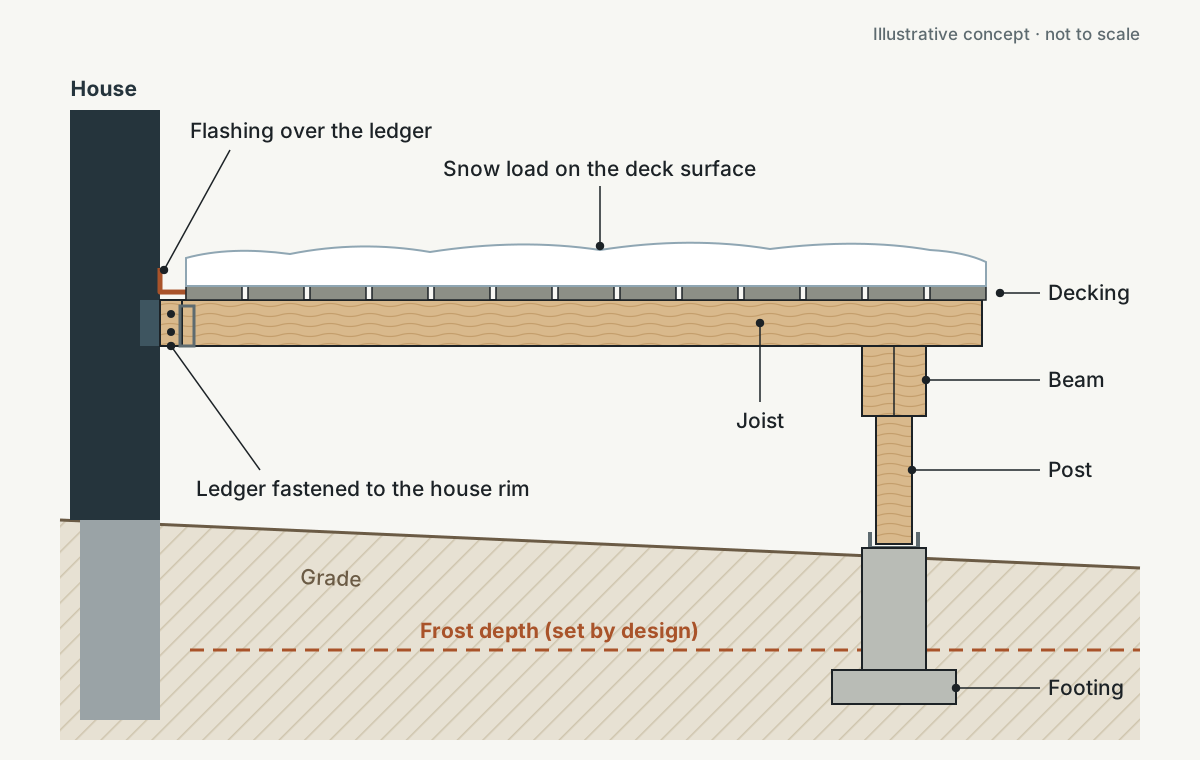
Water in the soil freezes and expands. A footing that sits above the frost line can heave in winter and settle in spring, racking the frame and pulling at the ledger. Footings go below frost depth to avoid that.
Bozeman's design criteria set the bottom of footings at 36 inches minimum for one-story structures and 48 inches for two-story. Big Sky and Madison County publish no local figure.
The cold reaches deep into the year. NOAA's 1991-2020 normals for the Big Sky 2WNW station show a mean monthly low of 30.0 °F in May and 24.7 °F in October, and a median frost-free season of about 50 days. Contractors schedule footing pours around those nights, and cold-weather concrete needs protection while it cures.
Soils and slopes
Soils change from lot to lot. USDA soil data at a sample point in Meadow Village show cobbly loam on gentle slopes; a sample point near Mountain Village shows stony sandy loam on 15 to 45 percent slopes. Look up your parcel in the NRCS Web Soil Survey. Bozeman requires a site-specific geotechnical analysis at permit application, and on steep or rocky Big Sky lots a soils report is worth asking about.
Footing options include poured concrete piers, footings pinned to bedrock, and helical piers screwed into the ground. Each suits different ground and access. Before any of them, Montana law requires the excavator to notify the 811 center, and utility owners then have 2 business days to mark their lines.
Sun at elevation
Sun wears on the boards too. The World Health Organization says UV intensity rises by almost 10 percent for every 1,000 meters of elevation. At the Big Sky station's elevation of about 2,000 meters, that works out to something like 20 percent more UV than at sea level. Check the manufacturer's notes on fading and heat for dark boards in full sun.
Questions for your designer
- What ground snow load do the plans use, and did it come from the ASCE 7 Hazard Tool?
- How do the plans handle roof slide and drifting?
- How deep do the footings go, and who set that depth?
- Does the design call for a soils report?
- If there will be a hot tub, where is its framing and footing?
For the approvals that come before all of this, read who approves a deck around Big Sky. For river lots, see decks near the Gallatin River.
Sources
- Montana DLI Building Codes Bureau: Snow Load Information
- Montana DLI Building Codes Bureau: Local Government Program list (2026-10-07)
- Montana DLI Building Codes Bureau: Current Codes
- City of Bozeman: Design Criteria
- ASCE Hazard Tool
- Montana State University: Montana Ground Snow Load Finder
- NOAA NCEI: U.S. Climate Normals 1991-2020
- USDA NRCS: Web Soil Survey
- Montana Code Annotated 69-4-503: Excavation notice
- World Health Organization: Ultraviolet radiation FAQ
Rules, rates, and costs change. Confirm details with the agency or a qualified professional before you act on them.
Send a request
Requests sent here go to an independent local deck contractor, not to a company that operates under this site's name.
(406) 641-7641 Send a deck requestKeep reading
-
Who approves a deck around Big Sky
Big Sky has no local building department, but a deck still faces approvals: a county Land Use Permit on the Gallatin side, committee review under covenants, floodplain rules, and a state electrical permit.
-
Decks near the Gallatin River: setbacks and floodplain permits
On the Gallatin County side of Big Sky, structures stay 100 feet from the Gallatin River's main branch and 50 feet from other watercourses. Floodplain permits are a separate question, with their own maps and ordinance.
Planning a deck in Big Sky?
Describe the lot and the project. The request goes to an independent local contractor.
Service area
- Big Sky
- Bozeman
- Gallatin Gateway
- West Yellowstone
- Ennis
- Moonlight Basin
- Spanish Peaks
Landmarks
- Lone Mountain
- Spanish Peaks
- Gallatin River
- Big Sky Town Center
- Meadow Village
- Mountain Village
- Yellowstone National Park